Active Recall and Dual Coding in Practice: The Educational Value of Flashcards for Children.
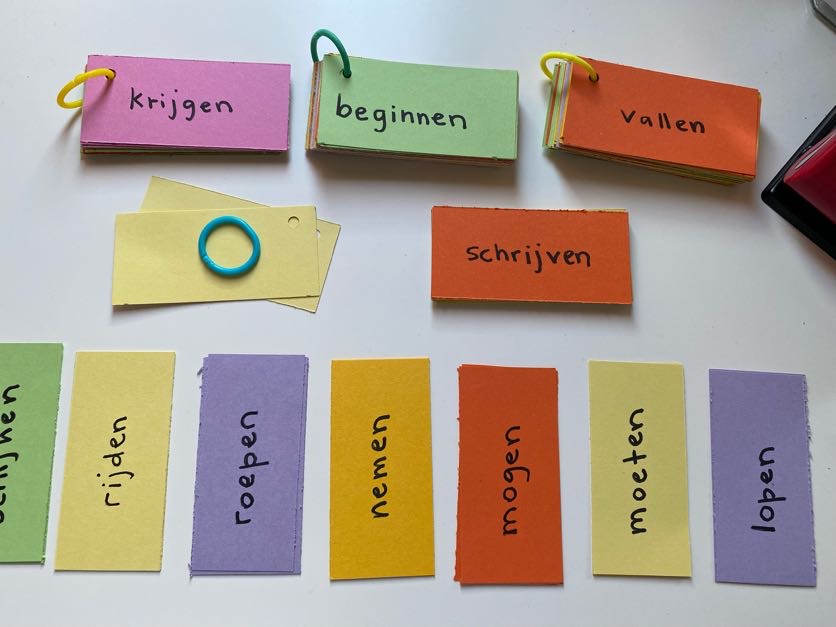
Flashcards and synoptic tables have always been part of the way I learn, and I genuinely enjoy making them. My set of Dutch irregular verb flashcards, in particular, inspired me to write this article.
Flashcards are a widely used instructional tool that combine visual and verbal elements to support children’s learning. Their effectiveness can be understood through principles of cognitive psychology and educational research, which highlight the value of active recall, dual coding, and spaced repetition.
From a cognitive perspective, flash cards promote retrieval practice, the act of recalling information rather than simply reviewing it. Research has consistently shown that retrieval strengthens long-term memory and improves learning outcomes (Roediger & Butler, 2011). Unlike passive study methods, flashcards require learners to generate an answer, which enhances encoding and retention.
The visual design of flashcards also aligns with dual coding theory (Paivio, 1986). When information is presented in both verbal and visual formats, such as a picture of an animal paired with its name, children are more likely to form robust mental associations. This dual representation supports comprehension and recall, particularly for younger learners or children developing vocabulary in a second language (Nation, 2013).
Furthermore, flashcards can be integrated into spaced repetition systems, which introduce increasing intervals between review sessions. Research indicates that spacing learning episodes significantly enhances retention compared to massed practice (Cepeda et al., 2006). When flashcards are revisited over time, children strengthen memory traces and reduce the likelihood of forgetting.
Flashcards also provide opportunities for differentiated instruction. They can be tailored to developmental level, learning goals, or cultural context, making them versatile across diverse educational settings. Studies on early literacy and numeracy interventions have found that children benefit from the use of flashcards to support recognition of letters, words, numbers, and mathematical symbols (Ehri, 2014; Purpura et al., 2017).
In conclusion, the effectiveness of flashcards lies in their ability to combine visual cues with active recall and structured repetition. By drawing on established principles of memory and learning, flashcards represent a low-cost, adaptable, and evidence-based resource for supporting children’s cognitive development.
References
- Cepeda, N. J., Pashler, H., Vul, E., Wixted, J. T., & Rohrer, D. (2006). Distributed practice in verbal recall tasks: A review and quantitative synthesis. Psychological Bulletin, 132(3), 354–380.
- Ehri, L. C. (2014). Orthographic mapping in the acquisition of sight word reading, spelling memory, and vocabulary learning. Scientific Studies of Reading, 18(1), 5–21.
- Nation, I. S. P. (2013). Learning Vocabulary in Another Language (2nd ed.). Cambridge University Press.
- Paivio, A. (1986). Mental representations: A dual coding approach. Oxford University Press.
- Purpura, D. J., Napoli, A. R., Wehrspann, E. A., & Gold, Z. S. (2017). Causal connections between mathematical language and mathematical knowledge: A dialogic reading intervention. Journal of Research on Educational Effectiveness, 10(1), 116–137.
- Roediger, H. L., & Butler, A. C. (2011). The critical role of retrieval practice in long-term retention. Trends in Cognitive Sciences, 15(1), 20–27.
Leave a Reply