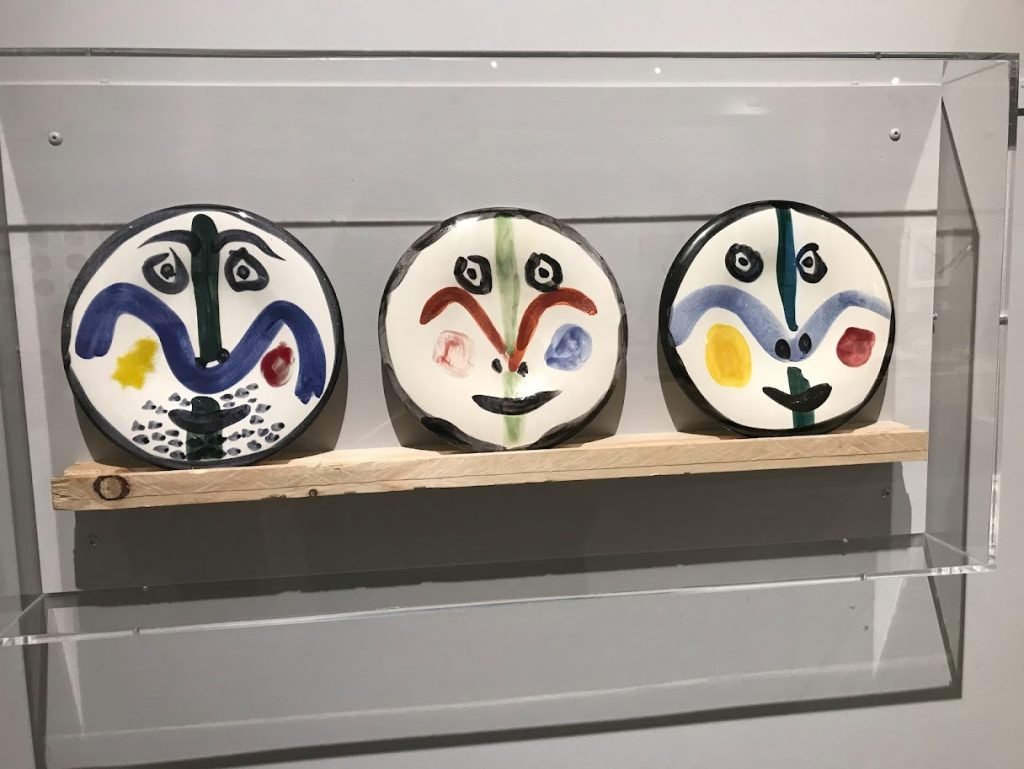
The Faces of Picasso: Exploring Art in Paper, Clay, and Glass
When I think of Picasso’s work, my mind goes into reverse film or slide mode. All the Picasso’s faces I’ve seen in museums and exhibitions start popping up one by one. Picasso’s faces are so distinct, with their bold lines, shapes, and expressions, that they almost seem to “project” themselves, much like images on a film reel or slide show.
It’s fascinating how Picasso’s exploration of faces, with all their emotional depth and geometric transformations, creates this kind of vivid mental imagery. His works seem to stay with you, each face representing a different moment or phase of his artistic journey. It’s as if every face he created is like a different frame in the ongoing story of his evolution.
Picasso isn’t just one of the greatest painters; he is also an endless source of inspiration. From his early drawings to his iconic paintings, his artistic journey led him to explore a wide range of mediums, including collage, oil painting, wood, bronze, textiles, various graphic techniques, ceramics, and even glassmaking.
Last year, in commemoration of the 50th anniversary of Pablo Picasso’s passing, the Royal Delft Museum held an exhibition showcasing some of his remarkable ceramic works: Picasso. Ceramic Magician.
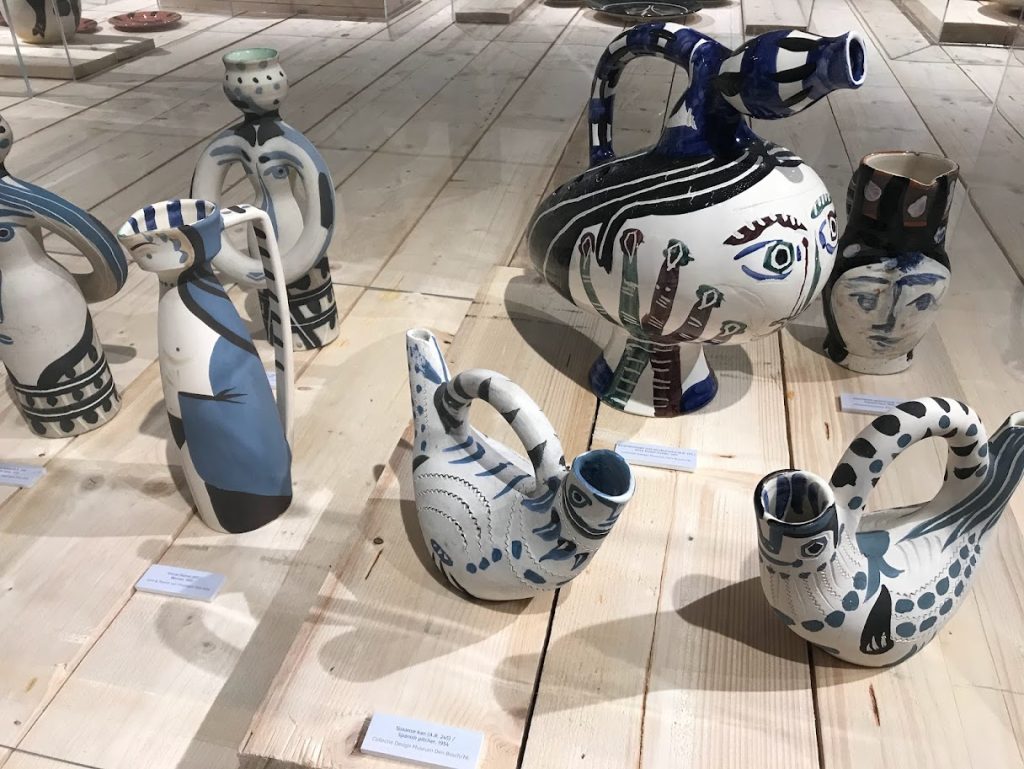
When you stand in front of a great artist’s work, the artist’s emotions speak to you. While Picasso was also an avid entrepreneur, and his faces became his signature brand, there was something much deeper beneath them.
Why faces? Where he found inspiration?
African masks offered Picasso a way to radically reimagine the human form, inspire emotional depth, and expand his artistic language beyond Western traditions. His famous painting, “Les Demoiselles d’Avignon” (1907), is often cited as being directly influenced by African masks. In this work, the faces of the women are rendered in a style that echoes the geometric, flat, and angular features seen in traditional African art. This marked a significant turning point in his career, transitioning him from a more classical approach to the pioneering techniques of Cubism.
“…The spirits, the unconscious, emotion, it’s the same thing. I understood why I was a painter… Les Demoiselles d’Avignon must have come to me that day – not at all because of the forms, but because it was my first canvas of exorcism -…”.
Picasso’s fascination with faces can be traced to several key aspects of his personality, his artistic evolution, and his desire to express complex ideas and emotions.
Exploration of Identity and Emotion:
Faces are the ultimate representation of identity and emotion. Picasso was deeply interested in capturing human expression and the inner complexities of people. Faces, with their ability to convey a wide range of emotions—from joy to sorrow, from anger to confusion—offered Picasso a way to explore these feelings in depth. Over the years, he experimented with how to depict faces to communicate not just physical likeness, but also emotional depth and personal identity.
Symbol of Human Connection:
Faces are central to human interaction, making them a universal symbol in art. Picasso was fascinated by how faces could convey the nuances of personal relationships and the human condition. His focus on faces allowed him to connect with his audience on a deeply emotional and universal level.
Breaking Convention and Experimentation:
As a revolutionary artist, Picasso wanted to break away from traditional ways of representing the human form. Rather than adhering to realistic portrayals, he experimented with abstract and cubist depictions of faces. By fragmenting and reassembling the face in his works, he challenged the way people viewed the world, showing that there are multiple perspectives of a single object or person. His fascination with faces allowed him to push boundaries in art.
Constant Reinvention:
Throughout his career, Picasso reinvented himself and his style many times. Faces were a central motif in that evolution, serving as a canvas for his different phases. Whether it was the classicism of his earlier works, the Cubist approach in the 1910s, or the more abstract and surreal faces in his later pieces, Picasso found new ways to approach the same subject matter, demonstrating his endless creativity.
Personal Life and Relationships:
Picasso’s personal relationships, particularly with women, heavily influenced his work. Many of his portraits and faces are representations of the important women in his life, such as his wives, lovers, and muses. His changing views of these relationships, and the emotions they stirred, were often expressed through his faces. The faces he painted and sculpted could represent love, heartbreak, passion, and sometimes even conflict.
A Form of Storytelling:
For Picasso, faces were not just about capturing a likeness—they were a way of telling stories. He often used the form of a face to symbolize deeper ideas or themes, whether it was the impact of war (as in Guernica) or the expression of inner turmoil. Faces allowed him to narrate personal and collective experiences.
In summary, Picasso’s fascination with faces was multifaceted. They served as a vehicle for emotional expression, a means to experiment with different styles, and a tool to explore identity, relationships, and the complexity of human existence. Faces were never static for Picasso—they were always evolving, reflecting his constant quest for new ways to see and interpret the world.
Exploring and Experimenting with Mediums
Picasso’s first drawings provide a fascinating glimpse into the early stages of his extraordinary artistic journey. From a young age, he displayed exceptional talent, capturing his surroundings with remarkable skill. His early works were grounded in realism, with portraits, still lifes, and sketches that showcased his technical mastery. However, even in these initial drawings, hints of his future innovations are evident—his ability to break down the human form and explore different perspectives was already taking shape. These early works laid the foundation for his later explorations in abstraction, offering rare insight into the development of one of the most influential artists in history.
Picasso’s paintings, filled with bold colors and unusual shapes, often feature faces that seem constructed from geometric forms like squares and triangles. He loved experimenting with different ways of representation, and each painting tells a unique story. Famous works such as Guernica (which depicts the pain of war) and The Weeping Woman (which conveys deep emotion) stand out as some of his most powerful visual statements.
Picasso was also a talented ceramic artist. Beginning in the 1940s, he worked with clay to create everything from simple plates to playful, colorful sculptures. His ceramics often featured faces and whimsical shapes, much like his paintings. Picasso’s experimentation with different textures and designs was a natural extension of his creative process, and his ceramics served as yet another medium for his boundless imagination.
In the 1950s and 60s, Picasso ventured into textile artwork, showcasing his bold creativity in a new form. He designed tapestries, rugs, and even clothing, incorporating his signature motifs—faces, shapes, and vibrant colors. Picasso’s textile pieces blended fine art with functional design, seamlessly bringing his iconic style into everyday life. These works reflect his constant drive to experiment with new materials and his ability to turn any surface into a canvas.
Later in life, Picasso began working with glass, carving and shaping it into unique pieces. These glass works were highly abstract, often incorporating themes such as faces and figures, much like his other art forms. His glass creations highlight his ability to think beyond traditional boundaries and explore new mediums with the same innovative spirit that defined his entire career.
In conclusion, Picasso’s exploration of faces through various mediums -whether on canvas, ceramics, textiles, or glass- demonstrates his relentless curiosity and boundless creativity. Each medium provided Picasso with a new way to express the complexity of the human form, breaking down and reconstructing faces in ways that challenged traditional perceptions of art. His ability to experiment with materials allowed him to continue evolving as an artist, offering fresh interpretations of the familiar and pushing the boundaries of artistic expression. Picasso’s faces, whether abstracted or playful, remain a testament to his genius, reflecting his constant drive to innovate and his belief that art should always be an adventure of discovery.
Leave a Reply